
Why 2025 Marks a Turning Point for Commercial Refrigeration
The commercial refrigeration landscape faces its most significant transition in decades as tightened F-gas regulations reshape the low GWP refrigerants market. The UK government's ongoing consultation on reforming the GB F-gas phasedown signals accelerated restrictions on high Global Warming Potential (GWP) hydrofluorocarbons (HFCs), pushing businesses towards immediate action. With hydrofluoroolefin (HFO) and natural refrigerant adoption becoming compliance necessities rather than optional upgrades, your refrigeration infrastructure requires assessment now.
This regulatory pressure creates unexpected financial opportunity. Businesses that retrofit to low GWP refrigerants before mandatory deadlines avoid emergency conversions at premium costs whilst accessing energy efficiency improvements that reduce operational expenses. The transition aligns with broader UK net zero commitments, positioning early adopters favourably for future environmental standards. Understanding your retrofit options, cost implications, and compliance timelines determines whether 2025 becomes a financial burden or a strategic advantage for your commercial refrigeration operations.
What Are the New Refrigerant Guidelines for 2025?
The UK government's consultation on F-gas regulation reform introduces stricter quota reductions for HFCs placed on the market, fundamentally altering which refrigerants you can legally use in commercial installations. These amendments accelerate the phasedown schedule to align with international climate commitments, reducing available supply of high-GWP options and pushing refrigerant costs upward through scarcity.
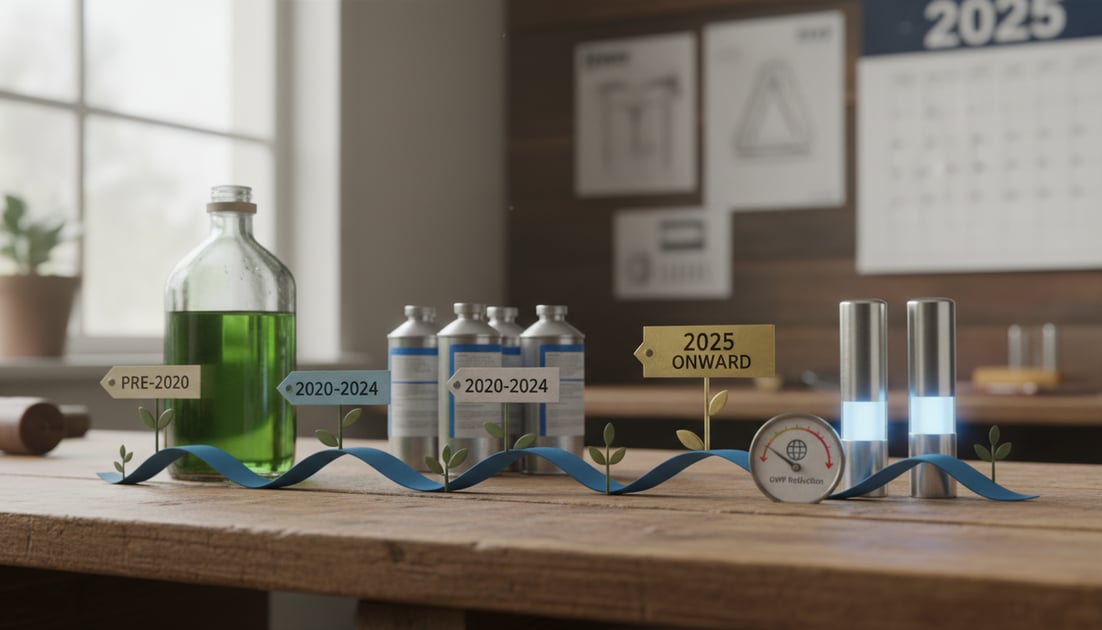
Current regulations already restrict certain applications, but 2025 marks the point where quota tightening makes traditional HFC refrigerants economically unviable for routine servicing. From 1 January 2027, new chillers above 12 kW must use refrigerants below GWP 750, effectively mandating options like R32 (GWP 675) or R454B. Natural refrigerants such as R290 (GWP 3) face fewer future restrictions, offering long-term compliance certainty.
💡 Tip
Assess your current refrigerant inventory against 2027 GWP thresholds now. Systems requiring frequent top-ups may become prohibitively expensive before mandatory replacement dates.
The regulatory framework creates a two-tier market: businesses proactively retrofitting to compliant refrigerants maintain operational control, whilst those delaying face constrained refrigerant availability and emergency conversions during equipment failures. Understanding these timelines determines whether your transition occurs on strategic terms or under crisis conditions that compromise both cost and equipment selection.
Complete List of Low-GWP Refrigerants for UK Commercial Applications
Your refrigerant selection determines both immediate compliance and long-term operational viability. The table below organises approved options by GWP category and typical commercial applications, helping you identify suitable alternatives for your specific equipment.
| Refrigerant | GWP Value | Application Type | Safety Classification |
|---|---|---|---|
| R290 (Propane) | 3 | Small retail cabinets, beverage coolers | A3 (flammable) |
| R744 (CO₂) | 1 | Supermarket systems, cold storage | A1 (non-toxic, non-flammable) |
| R1234yf | 4 | Transport refrigeration, display cases | A2L (mildly flammable) |
| R1234ze | 7 | Chillers, process cooling | A2L (mildly flammable) |
| R513A | 631 | Retrofit replacement for R134a systems | A1 (non-toxic, non-flammable) |
| R454B | 466 | Medium-temperature commercial refrigeration | A2L (mildly flammable) |
| R32 | 675 | Air conditioning, heat pumps | A2L (mildly flammable) |
Ultra-low GWP options (below 10) include R290, R744, R1234yf, and R1234ze. These natural and HFO refrigerants face minimal future regulatory risk, making them strategically sound for new installations. R290 delivers exceptional energy efficiency in smaller systems but requires careful handling due to flammability. CO₂ systems excel in high-capacity applications despite higher initial investment costs.
Low GWP alternatives (10-750) such as R454B and R513A provide drop-in or near-drop-in replacements for existing HFC systems. These bridge solutions offer compliance without complete system redesign, though they still face potential future restrictions as regulations tighten further.
⚠️ Warning
A2L refrigerants require updated safety protocols and ventilation assessments. Your installation team must hold appropriate refrigeration qualifications for handling mildly flammable options.

Safety classifications directly impact installation requirements and operational procedures. A3 refrigerants demand stricter charge limits and enhanced ventilation, whilst A1 options integrate into existing infrastructure with minimal modification.
Can R-454B Be Retrofitted into Existing R-410A or R-22 Systems?
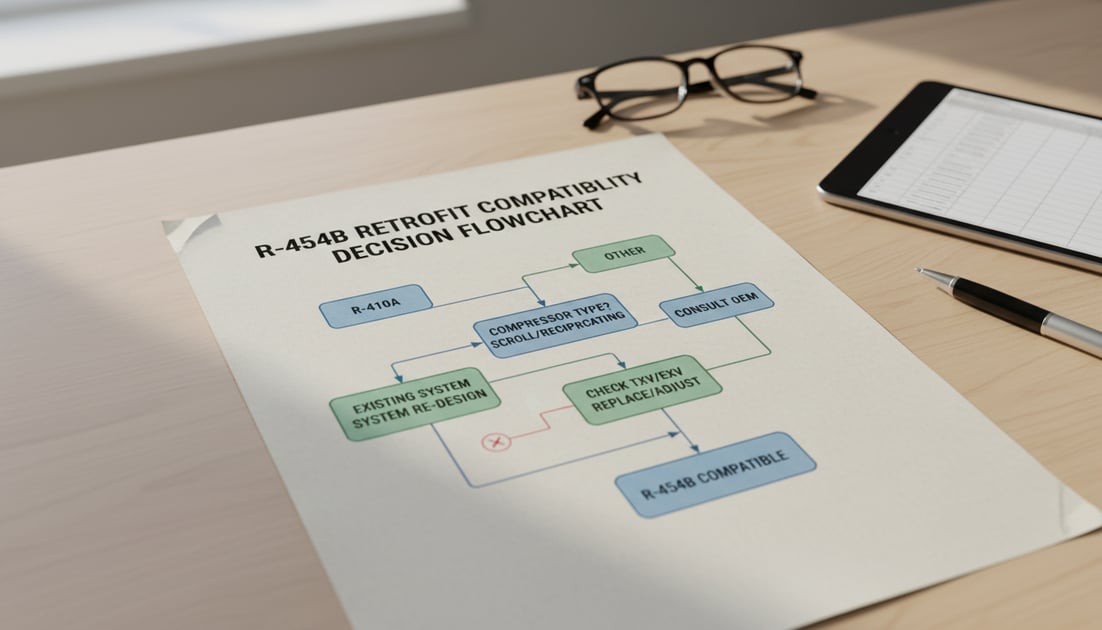
R-454B retrofits require systematic evaluation rather than simple refrigerant swaps. Follow these steps to determine compatibility and execute successful conversions.
Step 1: Assess System Compatibility and Pressure Ratings
R-454B operates at similar pressures to R-410A, making these systems mechanically compatible without major component replacements. R-22 systems require compressor and expansion device upgrades due to significantly different operating pressures. Your existing condensing units built after 2010 typically accommodate R-454B without structural modifications, whilst older R-22 infrastructure demands comprehensive component assessment.
Step 2: Replace Lubricants and Filter Driers
R-454B requires polyolester (POE) lubricant, incompatible with mineral oils used in R-22 systems. Complete oil drainage and flushing prevents contamination that degrades performance and damages compressors. Install new filter driers rated for A2L refrigerants to manage moisture and acid formation during the transition period.
Step 3: Update Safety Controls and Ventilation
A2L classification mandates refrigerant leak detection systems in occupied spaces. Install sensors calibrated for R-454B's lower flammability limit and verify mechanical ventilation meets current safety standards. Your installation must comply with updated environmental permits governing refrigerant handling.
Step 4: Verify System Performance Post-Retrofit
Commission the converted system with capacity testing and leak verification. R-454B delivers comparable cooling performance to R-410A whilst reducing GWP by 54%, but R-22 conversions may experience 5-8% capacity reduction requiring evaporator assessment.
💡 Tip
Professional fridge regassing services ensure proper charge quantities and system optimisation after retrofit completion.
That Commercial Fridge Repair technicians evaluate retrofit feasibility before conversion, preventing costly compatibility issues.
What Should Be Considered When Retrofitting a System with a New Refrigerant?
Successful refrigerant conversions demand methodical planning beyond simple refrigerant substitution. Follow this comprehensive checklist to avoid costly mistakes and ensure long-term system reliability.
- Lubricant Compatibility Analysis – Verify that your existing oil works with the replacement refrigerant. HFC-to-HFO conversions typically maintain polyolester (POE) lubricants, whilst R-22 systems require complete mineral oil removal. Residual incompatible oil causes compressor wear and reduced heat transfer efficiency, potentially shortening equipment lifespan by 40%.
- Component Pressure Rating Verification – Confirm that condensers, evaporators, and piping withstand the new refrigerant's operating pressures. R-454B operates at similar pressures to R-410A, allowing direct component reuse. Conversely, R-290 retrofits into R-22 systems may require pressure vessel recertification despite lower operating pressures due to flammability considerations.
- Safety Infrastructure Upgrades – Install leak detection systems for A2L and A3 refrigerants in occupied areas. Sensors must activate mechanical ventilation before concentrations reach lower flammability limits. Your electrical systems need classification updates when introducing flammable refrigerants into previously non-flammable installations.
- Expansion Device Recalibration – Replace or adjust thermostatic expansion valves (TXVs) to match the new refrigerant's thermodynamic properties. Incorrect metering causes flooding or starving of evaporators, reducing capacity by 15-25% even with proper refrigerant charge quantities.
- Charge Quantity Calculations – Determine precise refrigerant amounts based on manufacturer specifications rather than original system charge. Different refrigerants require adjusted volumes due to varying densities and thermodynamic characteristics. Overcharging wastes expensive low GWP refrigerants and reduces efficiency.
- Documentation and Labelling Compliance – Update system identification plates with new refrigerant type, charge quantity, and safety classification. Maintain conversion records including oil type, component replacements, and commissioning data for regulatory inspections and future commercial fridge repair services.
⚠️ Warning
Mixing refrigerants creates unpredictable pressure-temperature relationships that damage compressors and void warranties. Complete recovery prevents contamination during conversions.
Professional assessment identifies compatibility issues before conversion begins, preventing equipment damage from improper refrigerant selection.
Long-Term R-22 Replacement Options for Residential and Light Commercial AC
Selecting permanent R-22 replacements determines whether your residential or light commercial air conditioning system delivers reliable performance or faces recurring issues. The table below compares viable long-term alternatives by key operational criteria:
| Refrigerant | GWP | Retrofit Complexity | Cooling Performance vs R-22 | Safety Class |
|---|---|---|---|---|
| R-454B | 466 | Moderate – requires POE oil, new TXV | 95-98% capacity retention | A2L |
| R-32 | 675 | Moderate – pressure-compatible, leak detection needed | 100-105% capacity, higher efficiency | A2L |
| R-407C | 1,774 | Low – similar pressures, minimal changes | 90-95% capacity, temperature glide issues | A1 |
| R-290 | 3 | High – charge limits, electrical upgrades | 100-110% capacity, excellent efficiency | A3 |
R-32 dominates residential air conditioning retrofits due to superior energy efficiency and straightforward conversions from R-22 systems. However, stricter environmental regulations will progressively limit R-32 availability, making it a medium-term solution rather than future-proof choice.
R-454B provides balanced performance for light commercial applications requiring larger charge quantities where R-290's flammability restrictions become prohibitive. Systems retrofitted with R-454B maintain consistent cooling output whilst meeting current GWP thresholds.
⚠️ Warning
R-407C's high GWP places it outside 2027 compliance thresholds for new equipment. Use only as temporary bridge solution for systems nearing end-of-life replacement.
R-290 offers the strongest regulatory certainty with ultra-low GWP, but charge limits restrict residential applications to units below 150g refrigerant capacity. Light commercial installations require compartmentalised outdoor placement to meet safety standards.
That Commercial Fridge Repair technicians assess charge quantities and spatial constraints before recommending R-290 conversions for commercial cooling systems.
Retrofit Cost Analysis: What You'll Actually Pay in 2025
A medium-sized supermarket replacing R404A systems with R744 (CO₂) transcritical refrigeration faces £85,000-£120,000 in upfront costs but recovers investment through energy savings within 4-6 years. Central England Co-op documented 25% energy reductions across multiple store conversions, translating to £12,000-£18,000 annual savings per location. These real-world figures demonstrate how retrofit expenses divide between equipment, labour, and ongoing operational benefits.

Typical Retrofit Investment Ranges:
| System Type | R454B Conversion | R744 (CO₂) Replacement | R290 Installation |
|---|---|---|---|
| Small retail cabinet (2-5kW) | £1,800-£3,200 | £4,500-£6,800 | £2,200-£4,100 |
| Medium commercial system (10-20kW) | £8,500-£14,000 | £22,000-£38,000 | £12,000-£19,000 |
| Large supermarket installation (50kW+) | £45,000-£68,000 | £85,000-£145,000 | Not applicable |
Drop-in conversions to R454B minimise disruption with 2-4 day installations, whilst complete CO₂ system replacements require 10-15 days including commissioning. Labour represents 35-45% of total project costs, making phased conversions attractive for multi-unit operations spreading expenditure across financial quarters.
💡 Tip
Energy savings typically offset 18-22% of retrofit costs annually for CO₂ systems, improving payback timelines when combined with reduced refrigerant top-up expenses.
Asda reported 30% carbon emissions reductions alongside energy savings from R744 installations, positioning retrofits as dual-purpose investments addressing both regulatory compliance and operational efficiency. That Commercial Fridge Repair provides detailed cost-benefit analysis comparing retrofit options against your current energy consumption data.
Drop-In vs. Non-Drop-In Refrigerants: Compatibility Matrix
Understanding refrigerant compatibility determines whether your retrofit proceeds smoothly or encounters expensive component failures. Drop-in alternatives allow direct substitution with minimal system modifications, whilst non-drop-in options require comprehensive infrastructure changes including lubricant replacement and component upgrades.
| Refrigerant Type | Original System | Oil Change Required | Component Modifications | Installation Time |
|---|---|---|---|---|
| Drop-In | R404A → R448A | No (POE compatible) | None | 4-6 hours |
| Drop-In | R134a → R513A | No (POE compatible) | None | 4-6 hours |
| Near Drop-In | R410A → R454B | Yes (POE flush) | New filter driers, TXV adjustment | 8-12 hours |
| Non-Drop-In | R22 → R32 | Yes (mineral to POE) | Expansion valve, leak detection, ventilation | 16-24 hours |
| Non-Drop-In | R404A → R290 | Yes (mineral to POE) | Compressor, electrical classification, charge limits | 20-30 hours |

Lubricant miscibility drives compatibility outcomes. R448A and R449A maintain solubility with existing polyolester oils in R404A systems, eliminating oil drainage procedures. Conversely, R22 conversions to R454B demand complete mineral oil removal because incompatible lubricants create acid formation and compressor bearing damage.
⚠️ Warning
Thermostatic expansion valves calibrated for R22 cause refrigerant flooding when used with R32 or R454B, reducing capacity by 20-30% despite correct charge quantities.
That Commercial Fridge Repair conducts oil analysis and pressure testing before recommending drop-in versus complete system replacement strategies.
UK Case Study: Asda and Central England Co-op Retrofit Results
Asda converted 12 stores to R744 transcritical systems between 2022-2024, achieving 28-32% energy consumption reductions compared to legacy R404A installations. Their Leeds Harehills location recorded £16,400 annual electricity savings alongside 34% carbon emissions cuts, validating ultra low GWP refrigerants as financially viable beyond compliance requirements. Installation costs averaged £98,000 per store with payback periods of 5.2 years based on documented energy performance.
Central England Co-op implemented R290 systems across smaller format stores, documenting 22% energy savings in convenience retail environments. Their Uttoxeter branch demonstrated that natural refrigerant retrofits deliver measurable returns even in sub-10kW applications, where charge limits previously discouraged adoption. Total conversion costs reached £14,200 per location with 6.8 year payback timelines.
💡 Tip
Both retailers achieved faster payback when combining retrofits with LED lighting upgrades and improved door seals, maximising energy reduction opportunities during planned downtime.
The low GWP refrigerants market increasingly favours CO₂ and hydrocarbon solutions based on these verified performance metrics. Asda's maintenance teams reported 40% fewer refrigerant top-ups annually compared to HFC systems, reducing both compliance administration and operational costs. Central England Co-op noted simplified regulatory reporting requirements with ultra-low GWP options eliminating quota allocation concerns entirely.
Your Next Steps Before 2025 Deadlines
Begin your refrigerant transition assessment immediately rather than waiting for quota restrictions to force emergency conversions. Inventory your current systems against 2027 GWP thresholds, identifying equipment requiring frequent top-ups that will become cost-prohibitive under tightened HFC availability. DEFRA's consultation proposes achieving 98.6% quota reductions by 2048, accelerating the compliance timeline beyond previous targets and making proactive planning essential.
That Commercial Fridge Repair technicians evaluate retrofit feasibility and recommend compliant refrigerant options matching your operational requirements and budget constraints. Professional installation ensures proper lubricant compatibility, safety infrastructure upgrades, and performance optimisation that prevent costly rework. Contact us to schedule system assessments before 2025 deadlines create service bottlenecks and inflated conversion costs across the commercial refrigeration sector.